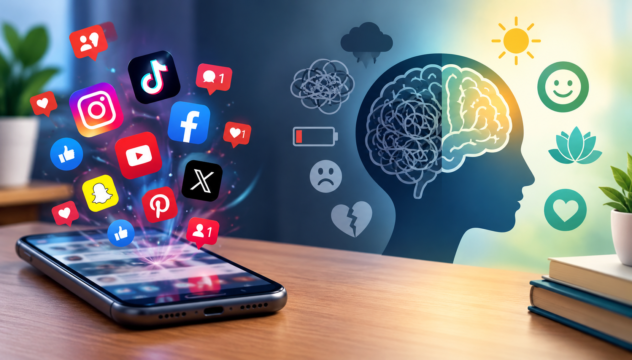
Understanding the mental health effects of social media is important today for adults, parents, and young people across the United States. Billions of people use these platforms, and they shape how we see ourselves, how we relate to others, and how we understand the world.
Research shows that social media can have both positive and negative effects. Which one you experience depends on how you use it, how long you use it, and who you are (for example, your age or life situation).
This guide draws on recent research and explains the topic in simple, practical terms.
I can also make it shorter, or write it in a more engaging style for a blog or social post if you like.
What Is Social Media?
Social media refers to websites and apps where people can post photos, videos, text, or updates online, share them with others, and have conversations. Popular examples include Facebook, Instagram, TikTok, X (formerly Twitter), Snapchat, YouTube, and LinkedIn. Users follow others and can react to their posts right away.
These platforms started in the late 1990s and early 2000s as simple ways to connect with people. Today they are a main place for news, entertainment, business promotion, and staying in touch with others. In wealthy countries, almost all teenagers and a large share of adults use at least one platform regularly. The biggest feature is that communication goes both ways, not just one way. In other words, you don’t only watch, you can respond too.
Benefits of Social Media for Connection and Support
Many people who feel alone or isolated offline find that, when used mindfully, social media can genuinely support their mental well-being. There they can find people like themselves and a community of their own. Teenagers also often say these platforms make it easier to stay in touch with their friends. In a 2025 Pew Research Center survey, 74% of American teens said social media makes them feel closer to their friends, and 63% said it gives them a place to express their creativity.
How you use it matters most. The benefits are greatest when you use it actively and with a clear purpose, for example sharing your own news, messaging close friends, joining groups about your interests, or getting help from peers. These activities strengthen the feeling of “I belong to this group.” In hard times, online communities can reduce the shame or hesitation around talking about mental health, and they can also offer useful advice.
According to Gallup data from multiple countries, moderate use is linked to fewer negative feelings and higher satisfaction with life. Both very little use and excessive use have been found to bring worse results than this.
For some young people, social media is even more valuable. Those who live in rural areas, have disabilities, or are still figuring out their identity can find online the support and understanding they cannot easily get in their offline lives. These positive sides are truly important, and they should not be overlooked when discussing the effects of social media on mental health.
A large review of studies that researchers conducted over many years found that people who give a lot of time and attention to social media show more of these problems: low mood or depression, worry or anxiety, behavioral problems, and thoughts of harming themselves.
Another analysis looked at 153 studies together, covering about 360,000 children and teenagers. It found a particular link between social media and poorer mental, social, and physical health outcomes.
A 2025 Pew survey asked American teenagers about this. The results were as follows:
- 48% think social media mainly has a bad effect on people their age. This number has risen compared with previous years.
- About 19% said it has harmed their own mental health.
- The rate is higher among girls: 25% of girls said it has harmed them, compared with 14% of boys.
- 45% said it disturbs their sleep, for example by staying up late on their phones or notifications waking them up.
People commonly mention these causes. Social comparison: seeing other people’s polished, well-arranged lives and feeling small by comparison. FOMO (fear of missing out): the feeling that everyone else is doing something and others are leaving you out. Idealized images: feeling dissatisfied with yourself after seeing pictures of someone’s beautiful appearance or perfectly arranged life. Cyberbullying: harassment or teasing online. Constant notifications: alerts repeatedly breaking your attention.
Some studies have found that using social media for more than three hours a day roughly doubles the risk of poor mental health outcomes. People who use it very heavily feel their lives are worse than moderate users do, and they feel more anger, loneliness, sadness, and stress.
However, not all studies find a strong effect. Even so, the weight of recent evidence supports being cautious about excessive or passive scrolling. This does not mean social media is harmful in itself. The message is that moderation and awareness are needed.
Children and teenagers are the most at risk from the effects of social media. However, it is not only how long they use it that matters. What they see and when they see it are just as important. And when used properly, it can also be beneficial.
At this age the brain is still developing, a sense of identity is forming, and friends’ opinions matter a great deal. So other people’s reactions or comparisons can easily leave a deep mark on their minds.
A large long-term review found that heavy social media use is consistently linked with worse outcomes, such as more depression and outward behavioral problems.
This link appears strongest at around 12 to 15 years of age. Girls generally feel more pressure about their body image and a drop in self-confidence.
In a recent survey, many parents named social media as one of the biggest worries for teenagers’ mental health, sometimes bigger than all other causes. Being online all the time is breaking their concentration, cutting their sleep, and increasing quarrels among friends.
Some studies have found a link between excessive use and lower grades and lack of focus. On the other hand, when it is used with clear rules, these platforms can help build learning groups and support creative work.
The US Surgeon General’s advisory and various academic reviews stress that the number of hours spent is not the only main issue. These things also need to be looked at:
What kind of content they are watching
And when they are watching, for example whether it is late at night
Whether that teenager personally has any risk factors
Real world Example :Many teenagers look at filtered photos. In those photos everyone appears very beautiful, fair-skinned, thin, or flawless, which is not real. Seeing this again and again, they become unhappy with their own appearance, and this dissatisfaction is growing day by day. Another problem is that harmful trends or challenges (for example, doing something dangerous and filming it) spread very quickly on social media, and teenagers imitate them without understanding the risks.
The same platforms also become a place of support for many people. Some teenagers use them to create groups where people facing the same problems give each other courage and help. Others talk about mental health and make people more aware.
In short, the very medium that can cause harm can become a source of strength when it is used properly. What is being viewed and how it is being used is what really matters.
Practical Ways to Reduce Harm and Keep Benefits
The research points toward moderation and purposeful use. Simulation studies found that limiting use to about one hour a day, or replacing some scrolling time with physical activity, lowers the risk of depression. In a group of young American adults who tried a one-week social media detox, there were notable drops in anxiety (about 16%), depression (about 25%), and insomnia symptoms.
Helpful habits include:
Setting daily time limits or creating phone-free zones, especially before bedtime.
Turning off unnecessary notifications.
Choosing active participation (messaging friends, posting your own content) instead of passive scrolling.
Shaping your feed toward supportive or educational accounts, and unfollowing sources of comparison or negativity.
Using the wellbeing tools that many platforms now offer.
For parents: setting an example of healthy use, and talking openly with children about their online experiences instead of relying only on bans.
For those who are already struggling, professional support is important. Social media is rarely the only cause of mental health problems, but it can make existing vulnerabilities worse.
Conclusion
Social media is neither entirely good nor entirely bad for mental health. It has real benefits: staying connected with people, expressing creativity, and getting support from others. It also has real risks: comparing yourself to others, disrupted sleep, anxiety, and depression. These risks are highest among heavy users, especially girls and teenagers.
The strongest research shows that the effect depends on three things: how much time is spent, how it is used, and what the individual person is like.
So by understanding both sides and setting realistic limits on use, people of any age can enjoy the benefits while protecting their well-being. Research is still ongoing and the picture keeps getting clearer, but the evidence so far suggests that mindful, moderate use is the healthiest approach for most people.
Frequently Asked Questions
Does social media always harm mental health?
No, not always. Moderate, active use (chatting with friends, commenting) builds connection. Problems come from overuse, passive scrolling, and comparing yourself to others.