What Is a Panic Attack?
A panic attack is a sudden wave of intense fear or discomfort that strikes without warning, often with no clear trigger. If your heart suddenly starts racing, your chest feels tight, and you’re overwhelmed by a wave of fear, you may be experiencing a panic attack. They typically last between 5 and 20 minutes, though the emotional aftershock can linger longer. When someone has recurring panic attacks and lives with the constant worry of another one striking, it can start to feel exhausting and isolating. According to the National Institute of Mental Health, roughly 4.7% of U.S. adults experience panic disorder at some point in their lives, and many more have an isolated panic attack without ever developing the disorder.
Symptoms of a Panic Attack
How to Stop a Panic Attack: Breathing Exercises For Panic Attacks That Work
Breathing exercises for panic attacks work because slow, controlled breathing signals your parasympathetic nervous system — the “rest and digest” system — to switch on, which counteracts the fight-or-flight response driving the attack. Below are the most effective, research-backed techniques.
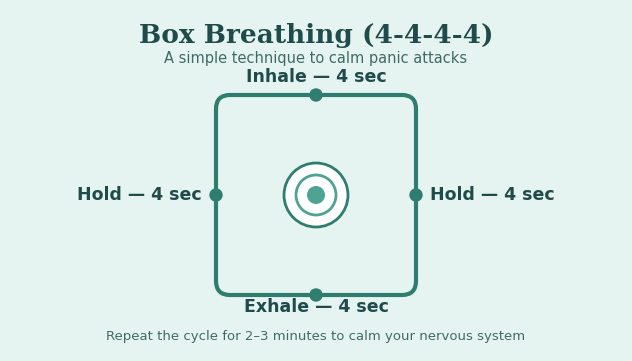
1. Box Breathing (4-4-4-4 Method)
Box breathing is used by Navy SEALs and first responders to stay calm under extreme stress, which makes it a powerful tool for civilians facing panic too.
How to do it:
- Inhale slowly through your nose for 4 counts
- Hold your breath for 4 counts
- Exhale slowly through your mouth for 4 counts
- Hold again for 4 counts
Repeat this cycle for 2–3 minutes. The equal counts give your mind a simple pattern to focus on, which interrupts the spiral of panicked thoughts.
2. 4-7-8 Breathing
Developed by Dr. Andrew Weil, this technique is specifically designed to slow the heart rate and trigger relaxation.
How to do it:
- Inhale quietly through your nose for 4 counts
- Hold your breath for 7 counts
- Exhale completely through your mouth for 8 counts, making a soft whoosh sound
Do this for 4 full cycles. The extended exhale is key — longer exhales activate the vagus nerve, which helps lower heart rate and blood pressure.
3. Diaphragmatic (Belly) Breathing
Most people breathe shallowly from their chest during panic, which actually worsens the feeling of breathlessness. Diaphragmatic breathing reverses this.
How to do it:
- Place one hand on your chest and one on your belly
- Breathe in slowly through your nose, letting your belly rise while your chest stays still
- Exhale slowly through pursed lips, feeling your belly fall
Practicing this for even 5 minutes can measurably reduce cortisol levels, according to a 2017 study published in Frontiers in Psychology.
4. Pursed-Lip Breathing
Often used by people with respiratory conditions, this technique also helps during panic because it naturally slows your breathing rate.
How to do it:
- Inhale through your nose for 2 counts
- Purse your lips as if you’re about to whistle
- Exhale slowly through pursed lips for 4 counts
This creates gentle resistance that prevents rapid, shallow breaths from taking over.
5. 5-5-5 Grounding Breath
Pairing breath with grounding can help when your mind feels like it’s spiraling out of your body.
How to do it:
- Breathe in for 5 counts while naming 5 things you can see
- Hold for 5 counts while naming 4 things you can touch
- Exhale for 5 counts while naming 3 things you can hear
This combines sensory grounding with breath control, pulling your attention back into the present moment.
Real Example: How Breathing Helped One Reader Regain Control
How to Help Someone Having a Panic Attack
The end of a panic attack doesn’t mean the discomfort disappears right away. Here’s how to support your recovery afterward.
Give yourself time. Fatigue, shakiness, or emotional sensitivity after an attack is normal and can last up to an hour.
Hydrate and rest. Panic attacks burn through adrenaline and cortisol, leaving your body physically drained and weakened.
Avoid caffeine after a panic attack, since it can make you more sensitive and reactive.
Write down what happened. It’s important to note possible symptoms and what helped you return to a calm state, since this information can be shared with a therapist if these symptoms happen again.
Consider professional support. If panic attacks are recurring, a licensed therapist can help through approaches like cognitive behavioral therapy (CBT), which the American Psychological Association identifies as a leading evidence-based treatment for panic disorder.
When to Seek Professional Help
Occasional panic attacks tied to stress are common, but if they’re happening frequently, disrupting your daily life, or forcing you to avoid places or situations out of fear of another attack, it’s definitely time to talk to a healthcare provider. A doctor or therapist can help determine whether you’re experiencing panic disorder and discuss options, including therapy, breathing-based interventions, and, when appropriate, medication.
Final Thoughts
Breathing exercises for panic attacks won’t make anxiety disappear from your life entirely, but they give you a practical, science-backed tool you can use anywhere the moment panic starts — sitting in your car, at work, or in a waiting room. The techniques above are simple enough to practice even when you’re calm, so they’ll feel familiar and you’ll be able to do them with ease when you need them most.
Frequently Asked Questions
1. What is the fastest way to stop a panic attack? Slow, controlled breathing — especially techniques with an extended exhale like 4-7-8 breathing — is one of the fastest ways to calm your nervous system during a panic attack, often within a few minutes.
2. Can breathing exercises really stop a panic attack?
Yes. Breathing exercises for panic attacks work by activating the parasympathetic nervous system, which counteracts the fight-or-flight response driving the attack, reducing heart rate and physical symptoms.
3. What does a panic attack feel like physically?
Common physical sensations include a racing heart, chest tightness, shortness of breath, dizziness, trembling, and nausea, which can feel similar to a heart attack.
4. How long do panic attacks usually last?
Most panic attacks peak within 10 minutes and subside within 20 to 30 minutes, although the experience can feel much longer because of the intense fear and discomfort. Even after the attack ends, some anxiety or fatigue may linger for a while.
5. What should you not say to someone having a panic attack?
Avoid saying things like “calm down” or “there’s nothing to be scared of.” Instead, tell them you know this is a really scary, painful feeling. Reassure them, acknowledge what they’re feeling, and calmly help guide their breathing.
This article is for informational purposes only and is not a substitute for professional medical or mental health advice. If you’re experiencing frequent or severe panic attacks, please consult a licensed healthcare provider or therapist.