Learning how to practice self compassion can transform the way you handle stress, setbacks, and everyday struggles.Learning to treat yourself with kindness is very important. When you find yourself in a challenging situation, treat yourself, or show yourself the same kindness you would show a close friend.In the United States, many people, regardless of gender, grow up believing that being hard on themselves is the only path to success. Yet research consistently shows the opposite. Self-compassion does not mean letting yourself off the hook. It means speaking to yourself with understanding in moments of stress—so that you don’t fall apart, and can learn from the situation and get back up again. Self-compassion reduces symptoms of depression and anxiety, and increases resilience and motivation. This guide will walk you through clear, evidence-based steps so you can start practicing it.
What Is Self Compassion?
Self-compassion means responding to your own failures, struggles, and shortcomings with warmth and understanding, rather than harshness. Kristin Neff, a leading researcher and psychologist at the University of Texas at Austin, defines it through three core components.(source)
The first is self-kindness. Instead of criticizing yourself for making a mistake, you extend yourself patience and care. The second is common humanity. You recognize that suffering and imperfection are part of being human, something everyone experiences, not proof that something is uniquely wrong with you. The third is mindfulness. You notice difficult feelings rather than ignoring them, without pushing them away or exaggerating them.
These three elements work together. Neff’s research, spanning more than two decades, has shown that people who score higher in self-compassion tend to report greater life satisfaction and lower levels of stress.
Why Self Compassion Matters for Mental Health
Self-criticism tends to make you want to avoid or punish yourself rather than actually correct the mistake. That creates ongoing stress. As a result, self-criticism raises cortisol levels, while self-compassion lowers the body’s stress hormone (cortisol) and helps keep the mind calm.
People with higher self-compassion also report greater relationship satisfaction and more motivation after failure, since they view mistakes as opportunities to learn rather than proof of inadequacy.
For health-conscious readers, the benefits aren’t limited to mood alone. Lower stress leads to better sleep, supports a stronger immune system, and contributes to improved long-term physical health.
How to Show Self Compassion in Daily Life
Self-compassion starts by noticing the gap between how you treat others and how you treat yourself. Suppose your friend spent two weeks working hard on a task, but it didn’t work out in the end, and he is devastated, falling apart. You comfort them: “You worked so hard for this, don’t be so hard on yourself, you’ll definitely do better next time.”
Now stop and think: in that same situation, what would you say to yourself? Would you comfort yourself, or blame yourself, probably feel guilty? Notice the difference: why do I think one way toward a friend and another way toward myself? That’s exactly where self-kindness toward yourself should begin. Be compassionate with yourself.
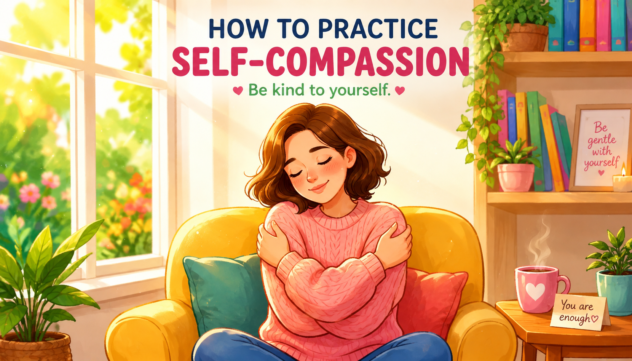
Place a hand on your chest, or gently hold your own arm. Research from Berkeley has shown that with regular practice, even just 20 seconds of supportive touch can improve emotional wellbeing. These small acts signal safety to your nervous system and make kind words feel more real.
Self Compassion Exercises You Can Try Today
Several practical exercises come directly from Neff’s work and the Mindful Self-Compassion program. They require no special equipment and can be done in a few minutes.
The Self-Compassion Break is ideal for stressful moments. First, acknowledge the difficulty by saying, “This is a moment of suffering” or “This hurts right now.” Second, remind yourself of common humanity: “Suffering is part of life. I am not alone.” Third, offer kindness: “May I be kind to myself” or “May I give myself the compassion I need.” Place a hand on your heart while you speak the words if it feels comfortable.
Another powerful exercise is writing a self-compassionate letter. Think of a situation that leaves you feeling inadequate or ashamed. Write a letter to yourself from the perspective of a wise, caring friend who knows everything about you and still accepts you fully. Research shows that people who wrote such letters daily for a week reported lower depression and greater happiness three months later.
A third practice is the “What would I say to a friend?” technique. When self-criticism arises, write down the exact words you would offer a close friend in the same situation. Then read those words back to yourself. This simple comparison often reveals how much harsher the inner critic is and makes the shift to kindness easier.
You can also keep a short self-compassion journal. At the end of the day, note any moment of struggle. Describe it with mindfulness, place it in the context of common humanity, and write a few kind sentences to yourself. Over time this rewires the default response from criticism to support.
Real-Life Examples of Self Compassion in Action
Consider a parent who loses patience with their child. Instead of blaming themselves — “I’m just a terrible parent” — they pause, acknowledge the day’s exhaustion, remind themselves that every parent has hard moments, and offer themselves a bit of rest or a kind inner message. The next interaction often goes better, because the parent isn’t acting from a place of shame anymore.
This example shows that self-compassion doesn’t lower standards. Research shows that people higher in self-compassion are actually more motivated to improve, because they aren’t paralyzed by fear of failure.
Building a Sustainable Practice
Think of self-compassion as a skill like any other — it grows stronger through practice. Start small, but stay regular and consistent.
- Begin with just one practice, once or twice a week — for example, writing yourself a brief kind letter, or whatever practice feels most natural to you.
- Feeling awkward at first is completely normal. Building a kind inner voice takes time, since your inner critic has years of experience behind it.
- Pair the practice with a simple physical cue. Placing a hand on your chest, gently holding your arm, or taking a few slow breaths can make the kind words feel more real and help calm your nervous system.
- At the end of the week, reflect on the moments when you were kinder to yourself. Celebrate small shifts rather than aiming for perfection. If you’re stuck in annoying traffic, offer yourself some reassurance.
- If the practice feels especially difficult, consider professional guidance. A therapist trained in compassion-focused approaches can help if past experiences make self-kindness feel unsafe or unfamiliar.
- Be patient and flexible. Some days the practice will come easily; as weeks and months pass, the kind response gradually becomes more automatic.
- Keep the long-term payoff in mind. Regular practice is linked to lower stress, greater emotional resilience, and improved wellbeing for both men and women.
Common Obstacles and How to Move Through Them
Some people worry that self-compassion is selfish or will make them lazy. Research strongly argues against this — self-compassion is associated with greater personal responsibility and healthier motivation, not less.
Women in particular may struggle with perfectionism or the drive to please everyone. Practicing common humanity reminds them that no one can meet every expectation all the time.
Putting It All Together
Practicing self-compassion is about gentle effort, not perfection. Start by understanding the three components. Whenever a difficulty comes up, use a brief practice like writing yourself a kind letter. Notice the difference between how you criticize yourself and how you’d treat a friend instead. Over time, the kind response becomes more natural.
The science is clear: people who build this skill experience less depression and anxiety. Start from wherever you are today, with whatever small step feels possible. Your future self will thank you for the kindness you choose to show yourself now.
Frequently Asked Questions
What is the difference between self-compassion and self-esteem?
Self-esteem often depends on success or comparison with others. Self-compassion remains steady even when you fail or feel imperfect because it is based on kindness rather than evaluation.
How long does it take to notice benefits from self-compassion practice?
Many people feel a shift after a few weeks of regular practice. Formal programs lasting eight weeks show measurable increases in self-compassion and reductions in stress and depression symptoms.
Can self-compassion make me less motivated?
People who are higher in self-compassion tend to feel more motivated after setbacks, because they aren’t weighed down by self-criticism.
Is self-compassion the same as self-pity?
No. Self-pity often involves isolation and exaggeration of suffering. Self-compassion includes common humanity and balanced mindfulness, which reduce feelings of isolation.
How can I practice self-compassion if I feel I do not deserve it?
If the thought arises — “I don’t deserve kindness” — recognize that many people feel this way, and try offering yourself one small act of care anyway. The sense of deserving it often grows only after the practice itself.